Environment Suitable for Entry: Comparison of Japanese Manufacturing Companies and Industrial Parks in Vietnam
Vietnam continues to stand out as a compelling destination for foreign manufacturers seeking to establish or expand production bases in Southeast Asia. With its strategic location, improving infrastructure and a growing ecosystem of industrial parks, the country offers an environment increasingly favourable for investment. In particular, Japanese manufacturing firms have been a major force in this expansion.
This article explores how Japanese companies operate in Vietnam, the role of Vietnam’s industrial parks in providing the right environment for entry, and how foreign investors can take advantage of both.
This article explores how Japanese companies operate in Vietnam, the role of Vietnam’s industrial parks in providing the right environment for entry, and how foreign investors can take advantage of both.

Japanese manufacturers investing in Vietnam's growing industrial zones and production bases in Southeast Asia
1. Japanese Manufacturing Firms in Vietnam
Japanese-owned manufacturers have been making strong inroads in Vietnam’s industrial sector. According to a report by B‑Company, as of 2023 there were more than 3,200 Japanese companies operating in Vietnam, accounting for more than 15 % of all foreign-direct investment (FDI) enterprises in the country. B-Company. Among these, approximately 30 % are located within industrial parks, with heavy concentration in the Southeast region (48 %) and the Red River Delta region (42 %). B-Company
The continuing presence of Japanese firms reflects several strengths: strong technical capability, established supply-chain relationships, and a willingness to invest in long-term manufacturing operations. Many Japanese manufacturers are active in electronics, automotive components, precision engineering and other higher-value production activities in Vietnam. For example, major electronics OEMs and component makers from Japan have chosen Vietnamese sites for part of their global supply-chain diversification.

Japanese-owned manufacturers expanding in Vietnam’s industrial sector — strong presence in Southeast and Red River Delta regions
However, Japanese investors also highlight some of the limitations: although Vietnam remains attractive, FDI from Japan into Vietnam in 2024 reportedly declined more than 48 % (to about USD 3.5 billion) as Japanese firms became more aware of investment and operational challenges in Vietnam. B-Company
2. Kizuna: The Ideal Industrial Environment for Manufacturing Entry
Kizuna represents a new generation of industrial park in Vietnam — one designed specifically to meet the needs of foreign manufacturing investors seeking speed, quality, and comprehensive support. Rather than providing only land or infrastructure, Kizuna delivers a complete business ecosystem that enables manufacturers to start production quickly and operate efficiently.
A Ready-Built, Ready-to-Operate Model
Located in Long An Province, just 50 minutes from central Ho Chi Minh City, Kizuna offers ready-built serviced factories ranging from 100 m² to 10,000 m². Each unit is equipped with modern utilities, 24/7 power and water supply, fire-protection systems, and high-speed connectivity. These facilities allow investors to begin production in weeks rather than months, eliminating the construction delays and regulatory complexity often seen in traditional industrial zones.
One-Stop Service Ecosystem
Kizuna’s strength lies in its one-stop service support, covering all essential areas of business operation — from investment licensing, labour registration, accounting, and HR services, to customs, logistics, and translation assistance. This integrated approach significantly reduces the administrative burden on investors, allowing them to focus entirely on production and market growth.
Strategic Location and Logistics Advantage
Situated at the gateway between Ho Chi Minh City and the Mekong Delta, Kizuna connects seamlessly to Cat Lai Port, Tan Son Nhat International Airport, and key industrial supply-chain routes. This prime location offers easy access to both domestic suppliers and international export markets, making it an ideal hub for manufacturing expansion in southern Vietnam.
Community of Global Manufacturers
Kizuna hosts more than 120 foreign-invested enterprises from Japan, South Korea, Europe, and other regions. These tenants form a strong, collaborative community that shares knowledge, resources, and business opportunities. Many companies expand their operations within the park — a testament to Kizuna’s stability and reliability. In fact, 95 % of tenants renew their lease after three years (Kizuna Internal Report, 2025).
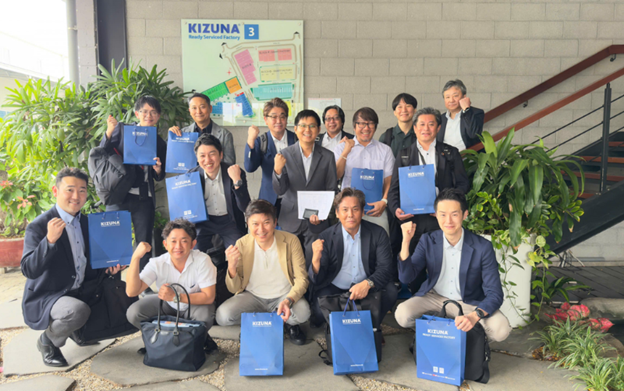
Foreign-invested enterprises at Kizuna Industrial Park — a collaborative community of Japanese, Korean, and European manufacturers
Sustainable and Safe Operations
Beyond infrastructure, Kizuna ensures environmental compliance and sustainability, with a complete wastewater treatment system and proactive fire-safety management. The park is maintained to international safety standards, giving investors peace of mind when operating in Vietnam.
3. Comparing Japanese Firms’ Approach vs. Industrial Park Environment
When we compare Japanese manufacturing companies’ approach and the broader industrial park environment in Vietnam, several observations emerge:
- Scale and sophistication
Japanese firms tend to bring higher technical standards, stronger quality control, and more advanced production systems (automation, lean manufacturing) than many local counterparts. This means they often target industrial parks with higher infrastructure standards and clustering opportunities. - Location selection strategy
Japanese manufacturers often choose industrial parks in traditional manufacturing hubs – e.g., the Southeast region (Ho Chi Minh City and surrounds) or the Red River Delta region (Hanoi, Hải Phòng) – because these provide strong logistics and available labour. This corresponds with the data showing concentration of Japanese firms in these zones. B-Company+1 - Infrastructure & service requirements
Japanese investors place high emphasis on stable utilities, predictable regulation, a supplier ecosystem and quality of logistics. Thus, parks that advertise “ready-built factory” options, reliable power and utilities, and one-stop services align well with their needs. The industrial park environment in Vietnam increasingly provides these, as noted in the InCorp Asia review. InCorp Vietnam - Speed of market entry
Industrial parks with ready infrastructure allow firms to reduce lead-time to production. For Japanese firms accustomed to disciplined production ramp-up, this is a key factor. The industrial parks’ high occupancy rates and availability of pre-built factory space support this. - Challenges and localization
Despite the supportive environment, Japanese firms still manage risks around regulatory complexity, land supply, labour skill levels and infrastructure quality depending on region. This suggests that even within good industrial parks, due diligence is required.
In short: Japanese manufacturing firms have relatively high entry- and operating-standards, and are choosing industrial parks in Vietnam that match those standards. For foreign investors more broadly, due-making of location, infrastructure and service quality via industrial parks is a best practice.
4. Implications for Foreign Investors
For investors (including but not limited to Japanese firms) considering manufacturing operations in Vietnam, the combined lessons from Japanese firms and industrial park developments offer practical guidance:
- Prioritize high-quality industrial parks: Choose parks with strong infrastructure, logistics access and segmentation of supplier/manufacturer clusters.
- Match your manufacturing strategy: If you plan high-value production (electronics, precision machinery), follow the Japanese model: select parks with high technical standards.
- Speed matters: Utilizing pre-built factory or ready-built units in industrial parks can drastically reduce setup time and cost.
- Location geography matters: Parks in key regions (Southeast – HCMC, Long An; Red River Delta – Hanoi, Hải Phòng) provide good connectivity and labour supply.
- Expect a strong service ecosystem: Good parks will offer licensing support, HR/ labour support, customs/ logistics and supplier networks—matching what Japanese firms value.
- Mitigate risks: Even in top parks, consider regulatory changes, labour skill gaps and infrastructure constraints; work with a local partner to navigate these.
5. Conclusion
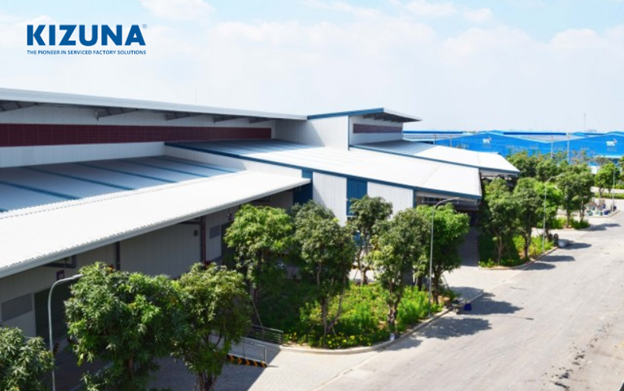
Modern ready-built factories at Kizuna — the ideal base for manufacturers expanding in Vietnam
Vietnam’s manufacturing environment – especially when supported by well-developed industrial parks – offers a strong platform for entry. Japanese firms already demonstrate how industrial parks can deliver the infrastructure, services and ecosystem required for successful manufacturing operations in Vietnam. For other foreign investors looking to benefit from this environment, choosing the right industrial park is a key step.
If you are planning to establish or expand your manufacturing operations in Vietnam, now is an excellent moment to act. Kizuna offers the ideal combination of location, infrastructure and support services to enable your success in Vietnam’s evolving manufacturing landscape.
Hotline: +84 (0)272 3900 123
Visit us at www.kizuna.vn to explore available units and support services.